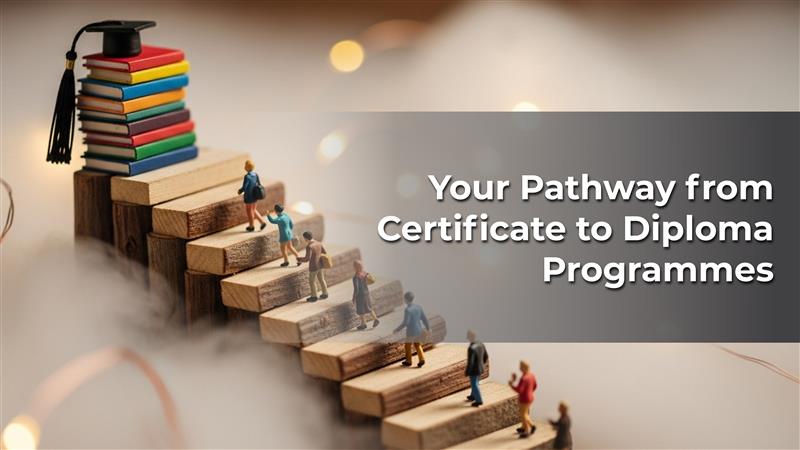
Completing a certificate programme is a milestone in your academic journey. It provides foundational knowledge in a specific area and serves as a stepping stone towards diploma courses in Malaysia.
Progressing to a diploma helps you gain in-depth knowledge, strengthen analytical skills, and enhance your career opportunities. Diploma programmes emphasise applied learning with strong industry relevance, preparing graduates for more specialised roles beyond entry-level positions. In addition, a diploma keeps future academic pathways open, supporting progression into higher qualifications and contributing to long-term career growth.
Steps to Transition from Certificate to Diploma
1. Choosing the Right Diploma Programme
The first step is to understand your interests and strengths. Reflect on what you enjoyed most while studying the certificate course. This can help you identify a diploma programme that builds on your existing knowledge.
To make a more informed choice, you may ask yourself the following questions:
- What were the topics that excited you the most?
- What are your strengths, and how can you align them with potential career paths?
2. Checking the Entry Requirements
Before applying to any diploma programme, it is essential that you review the specific entry requirements set by the institutions. Entry criteria in Malaysia often include academic qualifications such as SPM credits, related certificates or recognised equivalents, and some programmes may also require minimum scores in subjects such as English or mathematics.
3. Preparing Your Documents
Preparing your documents in advance can make your journey from a certificate to a diploma smoother and easier. Having all the required paperwork ready avoids last-minute delays.
You can start by gathering your academic documents, including your certificate transcript, completion certificate, and any other relevant educational records. Ensure that all information is accurate and up to date, as these documents are used to assess your eligibility for diploma admission.
4. Checking Institutional Accreditation
Before applying to diploma programmes, it is essential to check whether the institution offering the course is appropriately accredited. Accreditation confirms that an institution and its programmes meet recognised academic and quality standards, which can affect the course’s credibility and recognition.
In Malaysia, students can verify accreditation through recognised regulatory bodies such as the Malaysian Qualifications Agency (MQA). One of the most reliable tools is the Malaysian Qualifications Register (MQR), which lists accredited institutions and approved programmes.
In addition, students can review the institution’s official website to confirm its accreditation status with recognised authorities.
5. Apply Early and Strategically
Applying early gives you more flexibility, as diploma programmes often have specific intake periods and limited places. Submitting your application ahead of deadlines can improve your chances of securing a place on your preferred programme.
This also gives you time to address any gaps that may arise during the review process, such as providing additional documentation, meeting conditional requirements, or clarifying eligibility details with the institution.
Applying strategically means considering more than just availability. Take time to review intake dates, study modes, and progression opportunities to ensure the diploma programme fits your academic and personal goals. Some learners may benefit from an intake that allows additional preparation time, while others may prefer to progress immediately.
Available Diploma Courses at LSBF Malaysia
LSBF Malaysia offers a range of diploma programmes suitable for students who have completed certificate courses.
Diploma in Hotel Management
- Develops industry-relevant skills and foundational knowledge
- Provides an in-depth understanding of the hospitality sector
- Introduces learners to daily hotel operations and management practices
Diploma in Entrepreneurship
- Fundamental knowledge of business strategy, financial planning, and market analysis
- Insights into business development and risk management
Diploma in Computer Science
- Develops core principles and practices of computing
- Introduces essential programming tools and technologies
- Provides hands-on experience through lab exercises, coding projects, and collaborative assignments
Diploma in Psychology
- Covers foundational theories and concepts in psychology
- Develops analytical, communication, and research skills
Diploma in Occupational Safety and Health
- Builds competencies in workplace safety and health management
- Introduces key regulations, risk assessment, and emergency response practices
Diploma in Accounting
- Builds foundational knowledge in accounting principles and practices
- Covers financial accounting, management accounting, taxation, auditing, and financial reporting
Diploma in Human Resource Management
- Covers key HR functions such as recruitment, employee relations, performance management, training, compensation, and employment law
- Combines theoretical knowledge with practical application
Diploma in Business Administration (ODL)
- Builds foundational knowledge in areas such as accounting, finance, marketing, human resources, and operations management
- Develops critical thinking, problem-solving, and communication skills through hands-on projects
Diploma in Business Administration
- Foundational knowledge in key business areas such as accounting, finance, marketing, human resources, and operations management.
- Prepares the students for various roles- Business Analyst, Marketing Coordinator, and Human Resources Assistant.
Diploma in Digital Marketing
- Develops core digital marketing knowledge and applied skills
- Introduces key areas including SEO, SEM, data-driven and content marketing
Diploma in Logistics and Supply Chain Management
- Covers key concepts, technologies, and practices in logistics and supply chain operations
- Develops industry competence and awareness of legal and social responsibilities
Speak to our education consultant to know more about the Diploma programmes.
This blog is written by Godwin Fernandez
FAQs
1. Can I transition into a Certificate to Diploma programme in a different field?
Yes, it is possible to transition into a diploma programme in a different field, but this depends on the institution’s entry requirements and the relevance of your prior studies.
2. What happens if my certificate institution isn’t accredited?
If your institution of study is not accredited, it may affect your eligibility for entry into a diploma programme, particularly at institutions that require recognised qualifications.
3. Do Certificate to Diploma programmes require entrance exams?
In most cases, certificate-to-diploma programmes do not require entrance exams. Admission is typically based on meeting academic entry requirements, such as holding a recognised qualification and meeting any subject or grade requirements set by the MQA.

SUGGESTED COURSE
Diploma Programmes
Explore our transformative learning opportunities at LSBF, designed to equip you for a thriving and dynamic future. Enroll today and begin your journey towards academic innovation and personal development.