By Rathakrishnan Govind, CEO, LSBF Global
Higher education has always been about preparing people for the future.
Today, the challenge is that the future is arriving faster than education has traditionally been designed to anticipate.
Artificial intelligence is reshaping professions. Technology is changing how people work. Employers are rethinking the skills they need.
Students and families are also asking increasingly important questions:
Is this education relevant?
Will it prepare me for the world of work?
What will I be able to do with what I learn?
At the same time, economic uncertainty, geopolitical shifts and changing patterns of international student mobility are reshaping the global education landscape.
For institutions such as LSBF, responding to this environment requires more than introducing new programmes or periodically updating curricula.
It requires us to rethink what it means to prepare a student for the future.
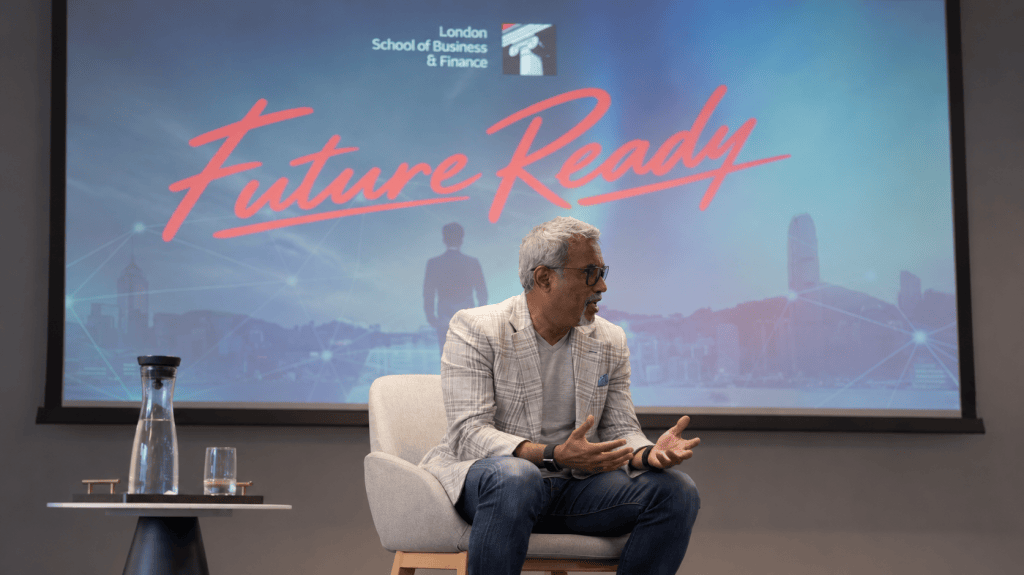
What Does “Future Ready” Really Mean?
I believe the next chapter of LSBF must be built around a simple ambition:
Every LSBF student should leave us more capable, more globally aware, more technologically empowered and better prepared for the world of work than when they joined us.
That is what being Future Ready should mean.
To achieve this, we are shaping our education proposition around four interconnected pillars:
- Industry-Relevant Programmes.
- AI-Integrated Learning.
- Student Mobility.
- Employability.
Together, they connect knowledge with application, technology with human capability, global exposure with perspective, and education with career readiness.
01 | Industry-Relevant Programmes
Relevance builds trust.
Academic quality and credibility will always be the foundation of education.
But today, quality must also include relevance.
The skills valued by employers today may evolve significantly in the years ahead. Education institutions therefore cannot design programmes in isolation from the industries and professions into which students will eventually enter.
At LSBF, our programmes must increasingly respond to employers, practitioners, technological developments and emerging skills requirements.
This is ultimately about trust.
Students are investing years of their lives, as well as significant financial resources, in their education. Their families are making that investment alongside them.
They should be able to trust that what they learn has relevance beyond the classroom.
Academic knowledge remains essential.
But it must be complemented by application.
The question we should ask is not only:
“What does a student know?”
It is also:
“What can that student do with what they know?”
02 | AI-Integrated Learning
Learning about AI is no longer enough.
Artificial intelligence is perhaps the most significant technological shift confronting education today.
Much of the debate focuses on whether AI will replace particular jobs.
For educators, I believe the more immediate question is:
How will AI change the way every profession works?
The accountant will work with AI.
The marketer will work with AI.
The entrepreneur, financial professional and cybersecurity specialist will increasingly work alongside intelligent systems.
Students therefore need more than an understanding of AI as a subject.
They need to understand how AI is applied within their chosen field.
Our ambition is to progressively embed industry-specific AI workflows into teaching and learning — helping students learn with AI, rather than simply about AI.
But being Future Ready is not about technology alone.
As AI makes information and routine execution increasingly accessible, human capabilities such as critical thinking, judgement, creativity, communication, leadership and ethics become even more important.
The future will require people who can combine human intelligence with artificial intelligence.
That is the capability we want to develop.
03 | Student Mobility
Global education should be a lived experience.
A global education should be about more than studying an international curriculum.
It should expose students to different cultures, economies, people and perspectives.
LSBF’s growing international footprint gives us an opportunity to make this a more meaningful part of the student experience.
Our vision is for students to experience LSBF not simply as an individual campus, but as an interconnected education ecosystem.
Singapore can offer one experience.
Kuala Lumpur another.
Shanghai and New Delhi can bring different academic, industry and cultural perspectives.
As our international network develops, each location can contribute its own strengths while remaining connected through a common educational philosophy.
International exposure can build capabilities that extend beyond the classroom — independence, adaptability, cultural awareness and the ability to communicate across different environments.
These capabilities matter in an increasingly interconnected world of work.
Our ambition is to create more opportunities for students to experience international education through different forms of mobility, from shorter international experiences to semester-based opportunities and structured progression pathways.
Mobility is not simply about where a student studies. It is about how they see the world.
04 | Employability
Education must connect to what comes next.
The fourth pillar brings the earlier three together.
What happens to our students after they graduate?
Graduation is an important academic milestone.
But it is not the end of a student’s journey.
For many, it marks the beginning of building a career and an independent life.
Employability therefore needs to be considered throughout the student experience — not introduced only towards graduation.
Students should progressively develop their professional identity while they study through industry exposure, practical projects, career planning, professional communication, networking and interview preparation.
I believe career readiness should begin from the moment a student enters LSBF.
Every academic experience, industry interaction and international opportunity should help students understand not only what they have studied, but how they can apply it in the world of work.
Our role is not simply to prepare students to graduate.
Our role is to prepare them for what comes next.
Beyond the Classroom
There is another dimension to becoming Future Ready.
We cannot provide a future-ready education while delivering an outdated student experience around it.
A student’s relationship with LSBF begins with their first enquiry.
It continues through admission, learning, support, mobility and careers.
And eventually, it becomes an alumni relationship.
Every interaction is part of the education experience.
That means our transformation must extend beyond the classroom.
Technology and AI should simplify processes, reduce unnecessary friction and help us respond more intelligently to student needs.
But technology alone will not create an excellent student experience.
People will.
A future-ready institution requires future-ready people — individuals who combine technical capability with service, empathy, accountability and a willingness to solve problems.
Every member of the LSBF community contributes to student success.
We therefore need to think beyond individual touchpoints and focus on one continuous student journey:
Discover → Learn → Experience → Grow → Launch → Lead → Stay Connected
At every stage, we should remain connected to the outcome we are trying to create.
Building the Next LSBF
LSBF is at an important stage in its development.
As our international footprint grows, we have an opportunity to build more than a network of campuses.
We can build an interconnected education ecosystem where:
- Programmes respond to industry.
- AI becomes part of how learning takes place.
- Students gain meaningful international exposure.
- Career readiness becomes part of the student journey.
And our people, processes and technology work together around one priority:
the student experience.
Growth alone is not the objective.
Better outcomes are.
Our four pillars provide the framework:
- Industry-Relevant Programmes create relevance and trust.
- AI-Integrated Learning develops future capability.
- Student Mobility builds global perspective.
- Employability connects education with the world of work.
Around these pillars, we need an institution defined by excellent people, excellent service, intelligent technology and an unwavering focus on the student experience.
We cannot predict every technology, profession or disruption that will shape the future our students enter.
But we can prepare them to navigate change.
And we can continue changing ourselves to support them.
That, to me, is what it means to make our students Future Ready.