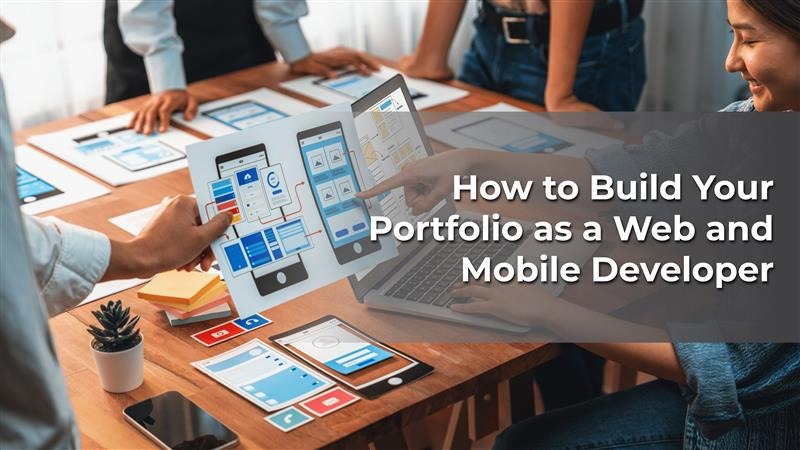
Web and mobile development is a practical discipline. Skills are built through projects, refined through iteration, and strengthened by solving real problems. A mobile or web developer portfolio brings these experiences together, showing how ideas translate into working web and mobile applications.
For those building a career in Web and Mobile Development, a portfolio complements your academic learning, such as a Bachelor’s Degree in Computer Science, by demonstrating technical thinking, creativity, and the ability to deliver complete solutions.
What Is the Purpose of Having a Developer Portfolio?
A developer portfolio exists to answer one simple question: “What can you actually build?” For a web developer or mobile developer, a portfolio is:
- A record of projects you’ve worked on
- A snapshot of the technologies you’ve used
- A reflection of how you approach problems
- A space where creativity isn’t limited by job scopes
Think of it as a personal museum of your work—past tech stacks, small experiments, case studies, and ideas that helped you grow as a web or mobile developer.
Why Employers and Clients Care About Portfolios
When employers review applications for web and mobile roles, they’re not just trying to confirm what you’ve studied; they’re trying to understand how you work. A CV can list modules, tools, and qualifications, but it rarely shows how those skills come together in practice.
This is where portfolios make the difference.
A research titled “Enhancing graduate employability through targeting ePortfolios to employer expectations: A systematic scoping review”, shows that employers use portfolios to assess real skills and work samples—the things that can’t be fully captured on a CV alone. Portfolios help them see how knowledge is applied, not just acquired.
A strong web developer portfolio shows:
- How comfortable are you with web and mobile development tools
- Whether you understand structure, usability, and performance
- How clearly can you explain your work
- How consistently you build, reflect, and improve
For entry-level roles, portfolios carry more weight than resumes because they demonstrate applied skills rather than academic knowledge.
What Are the Key Differences Between a Portfolio and a Resume?
A resume tells someone what you’ve studied and where you’ve been. A portfolio shows how you apply that knowledge in real situations. Key differences include:
| Resume | Portfolio |
|---|---|
| List qualifications and experience | Shows actual work and projects |
| Text-heavy | Visual and interactive |
| Static | Continuously evolving |
| Explains what you know | Proves what you can build |
Steps to Build a Portfolio as a Web and Mobile Developer
Step 1: Define Your Goals and Audience
Before building anything, be clear about who your portfolio is for and what it needs to communicate. Ask yourself:
- Are you targeting internships, junior web developer roles, or entry-level mobile developer positions?
- Do you want your portfolio to highlight web skills, mobile skills, or web and mobile development as a combined focus?
If you’re completing or close to finishing a BSc Computer Science programme, your portfolio should demonstrate that you can take a requirement and turn it into a working solution.
Step 2: Choose the Right Platform
Your platform is already part of your web dev portfolio. Common options include:
- A personal website with a custom domain
- GitHub Pages
- Portfolio builders (useful when starting out)
If possible, build your own site. Even a simple, well-structured site demonstrates fundamentals that matter to employers—HTML structure, CSS layout, responsiveness, and basic performance. That alone counts as one of your project portfolios.
Step 3: Highlight Your Best Projects
You don’t need professional projects to build a strong web developer’s portfolio. Quality always beats quantity. Treat each project as a case study and include:
- The problem you were trying to solve
- Your solution and decision-making process
- Technologies used
- Live demo or screenshots
- GitHub repository link
Academic projects, personal builds, or small experiments are all valid — as long as you explain your role and learning clearly.
Step 4: Showcase Both Web and Mobile Skills
If you’re pursuing Web and Mobile Development, make that obvious in how your projects are presented. Examples:
- Responsive web applications
- Cross-platform mobile apps
- REST API integrations are used by both web and mobile interfaces
- Consistent UI and UX patterns across devices
This balance helps position you as a versatile developer, even without industry experience.
Step 5: Write Clean and Honest Code
Recruiters do check repositories—especially for early-career roles. Focus on:
- Readable code structure
- Meaningful comments
- Proper naming conventions
- Clear commit history
Avoid copying code without understanding it. A simple, well-explained solution is far more impressive than complex code you can’t confidently talk about. This applies whether you’re building a web programmer portfolio or a mobile-focused one.
Step 6: Add an “About Me” Section
This is where personality meets professionalism. Keep it concise and focused. Include:
- Your learning journey
- Your career direction
- What excites you about development
- Technologies you enjoy working with
This section helps reviewers understand the person behind the projects, especially when work experience is limited.
Step 7: Include Skills and Technologies
List your skills clearly and honestly:
- Programming languages
- Frameworks and libraries
- Databases
- Tools and platforms
If you’re still developing confidence in certain areas, that’s fine. Accuracy builds trust, especially for those entering the industry through a bachelor’s degree.
Step 8: Make Your Portfolio Responsive and Fast
Your portfolio is a test project. Ensure:
- Mobile responsiveness
- Fast loading times
- Clean navigation
- Accessibility-friendly design
For a Web Developer or Mobile Developer, these are not optional — they’re expected.
Step 9: Add Contact Information and Calls to Action
Don’t make people hunt for you. Include:
- Email address
- GitHub or LinkedIn
- Clear calls to action, such as “View My Projects” or “Contact Me”
Even as a fresher, your portfolio should invite conversation.
Step 10: Keep Updating Your Portfolio
Growth over time is one of the strongest signals in a project portfolio. Update it when you:
- Learn new technologies
- Build stronger projects
- Improve older work
- Refine your career direction
What are the Common Portfolio Mistakes to Avoid
- Waiting until everything feels “perfect”
- Showing too many weak projects
- Not explaining your role in projects
- Copying without understanding
- Treating the portfolio as a one-time task
Fuel Your Learning and Professional Growth with LSBF Malaysia
Building strong project portfolios for your web and mobile development career starts with the right learning environment—one that balances theory with hands-on application.
The Bachelor of Science with Honours in Computer Science (Web and Mobile Development) offered by LSBF Malaysia in collaboration with the University of Suffolk equips you with exactly that balance. It’s a three-year UK-recognised degree delivered locally, designed to help you go beyond concepts and build real, demonstrable skills in areas that matter to employers.
What Makes This Bachelor’s Degree Programme Stand Out
- Industry-Aligned Curriculum: You start with core computing fundamentals like programming, networking and security, and progressively specialise in advanced web and mobile topics such as web development, mobile app engineering, distributed systems and cloud computing.
- Applied Project Work: By the final year, you undertake substantial projects that mirror real-world development tasks—perfect opportunities to create portfolio pieces that show how you solve problems, design systems, and deliver complete applications.
- UK-Recognised Degree: Graduates earn a BSc (Hons) Computer Science (Web and Mobile Development) degree validated by the University of Suffolk, a modern UK institution with strong graduate prospects and industry relevance.
- Flexible Intakes and Modes: With multiple annual intakes and options for full-time or part-time study, the programme supports a range of learning journeys
Explore the BSc (Hons) Computer Science (Web & Mobile Development) in Collaboration with University of Suffolk.
A blog written by Serin Thankam Sam
FAQs
Do I need a portfolio if I’m a beginner?
Yes. Especially as a beginner. A portfolio compensates for limited experience by showing initiative and learning progress.
Is a one-page portfolio enough?
Absolutely. If it’s focused, well-designed, and showcases your best work clearly.
Can I include tutorial or course projects?
Yes, but original thinking matters:
- Add your own improvements
- Explain what you learned
- Be transparent about the source
How often should I update my developer portfolio?
Ideally, every 3–6 months, or whenever you complete meaningful new work.
Should I include unfinished projects?
Only if:
- You clearly label them as work-in-progress
- They demonstrate a valuable concept or skill

SUGGESTED COURSE
Bachelor of Science with Honours in Computer Science (Web and Mobile Development) in Collaboration with University of Suffolk
This course is provided as a pathway on our BSc (Hons) Computer Science degree. All students begin their studies on the BSc (Hons) Computer Science degree before choosing the web and mobile development pathway towards the end of their first year of study. Students who complete this pathway will receive the specialist BSc (Hons) Computer Science (Web and Mobile Development) award at graduation.